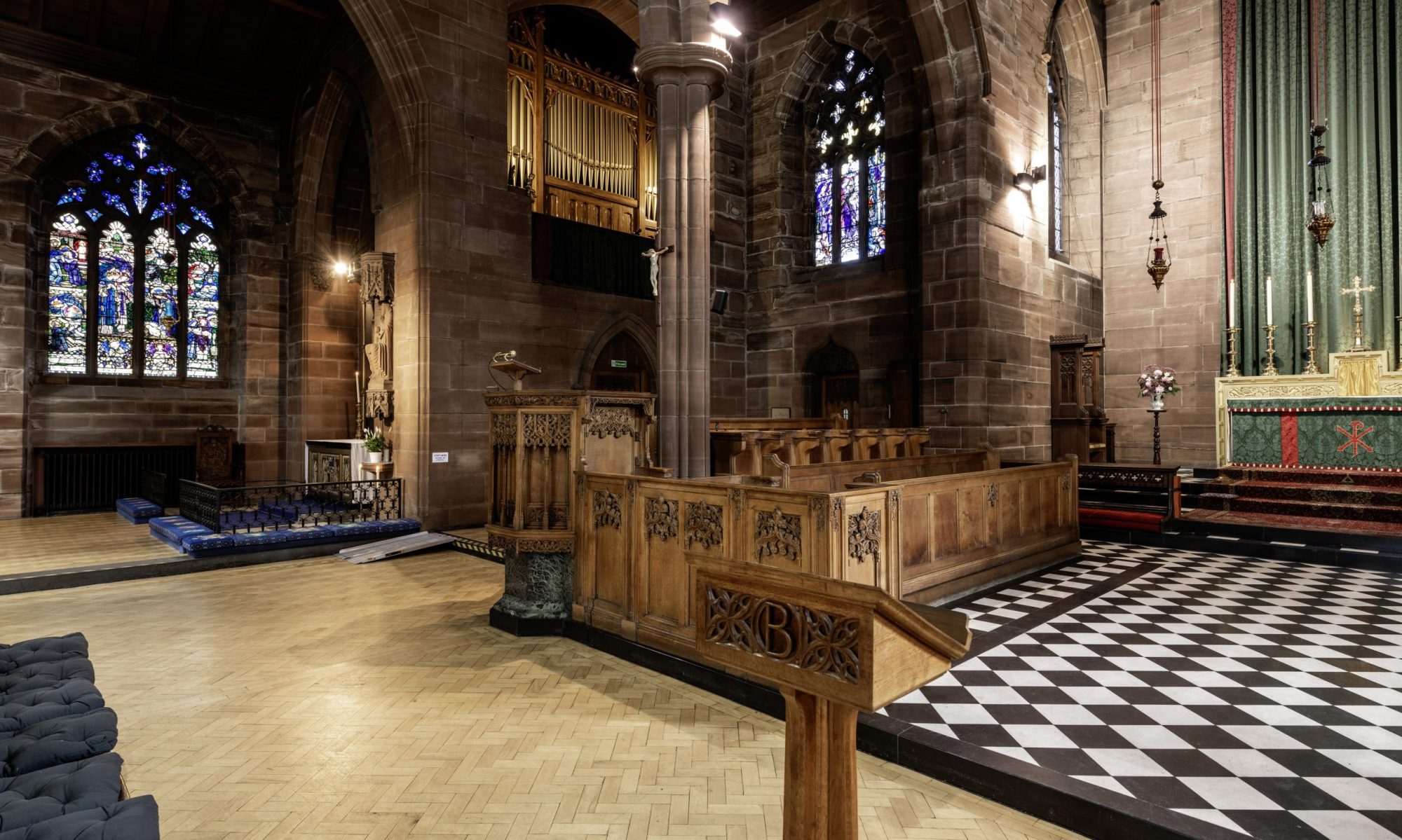
Built for Anderston Parish Church in 1864 by one of the most progressive organ builders in 19th century England, William Hill & Son, the organ was the first to be installed and used for worship in the Established Church of Scotland, and was inaugurated on 15 January 1865. As such, it is a uniquely important cultural asset of the City of Glasgow. The organ was enlarged with minor alterations in 1882 by Harrison & Harrison Ltd, and overhauled in 1903 by Mirrlees of Glasgow. Anderston Church closed in 1968 and was demolished, to be replaced by what was, until 2019, Anderston Kelvingrove Parish Church, with its distinctive pyramidal design. That building still exists today as a community hub for the Anderston area. In 1968, not long before the bulldozers moved in at Anderston, the organ was purchased by St Bride’s through the good offices of Robert Lamont and James Russell, former Choirmaster and Treasurer of St Bride’s respectively. The instrument was moved to St Bride’s, saved from modernisation (except for a modern pedalboard to replace the worn-out and unusable original from 1865, and the addition of two new Swell stops), and installed in 1971-72 by noted Glasgow organ builder James A. MacKenzie.
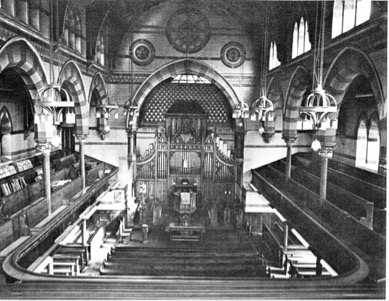
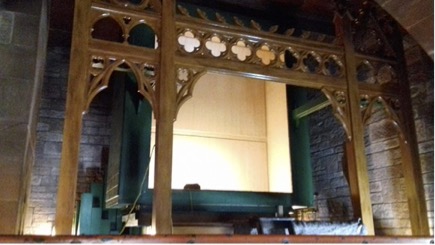
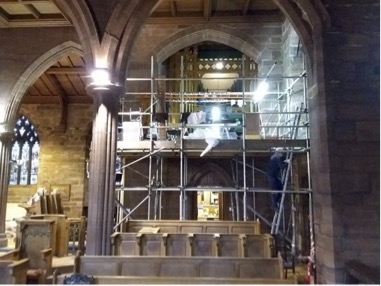
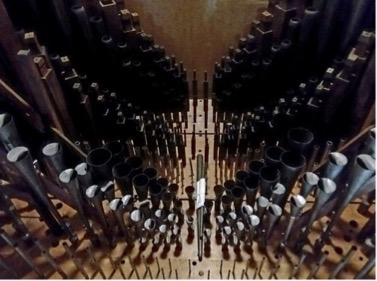
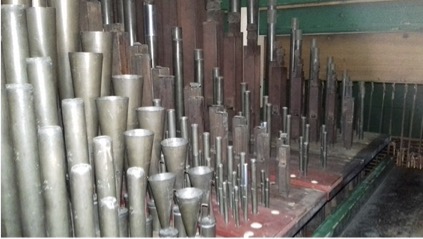
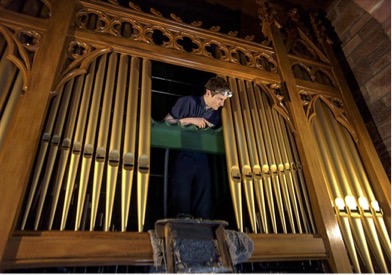
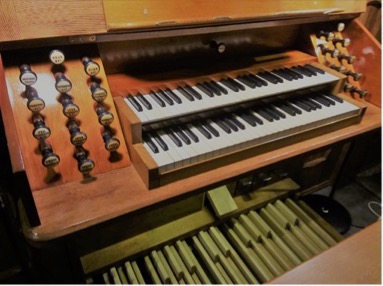
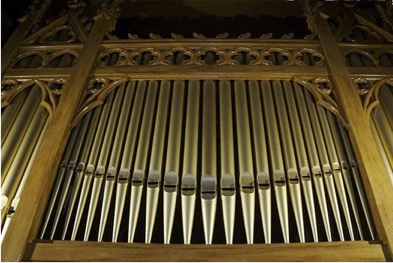
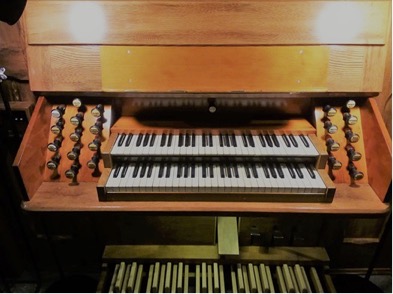
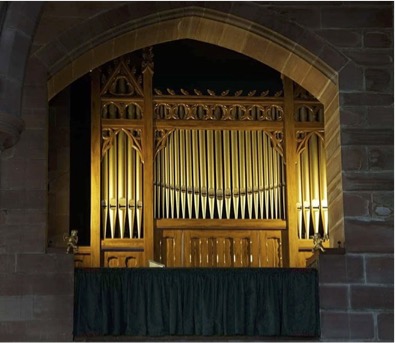
- Image 1: The Hill organ in its original home, Anderston Parish Church
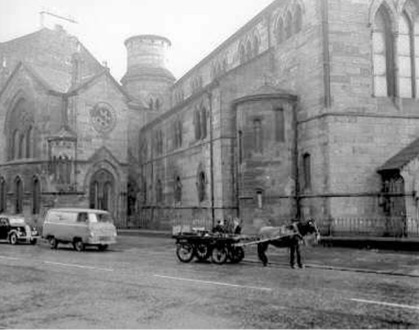
- Image 2: Anderston Parish Church original exterior
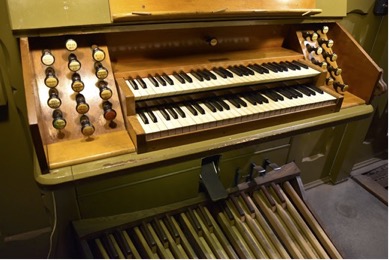
- Image 3: Organ console before restoration
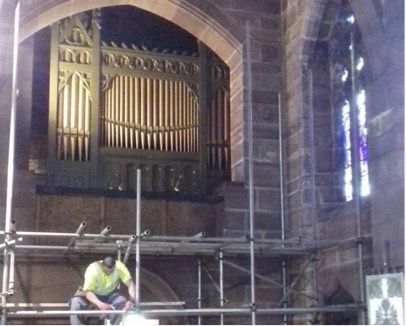
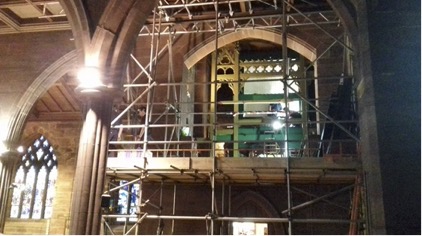
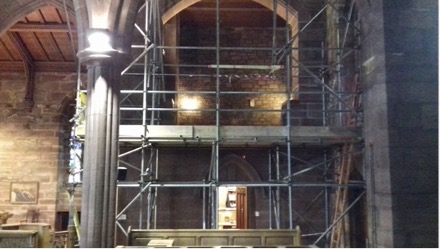
- Image 4: Scaffolding being constructed
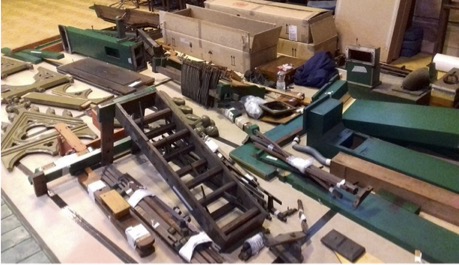
- Image 5: Pipework and mechanisms removed
- Image 6: Every item labelled for transportation
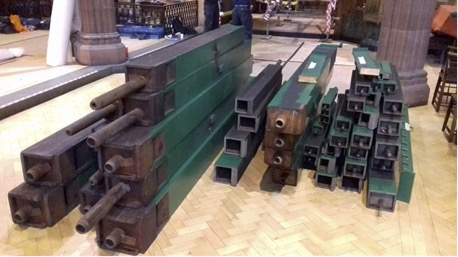
- Image 7: Pedal pipes ready for storage and cleaning
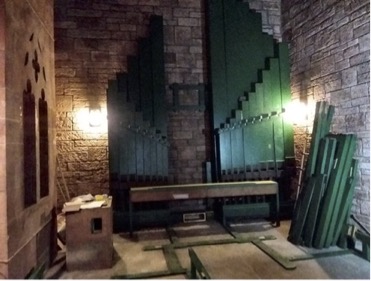
- Image 8: Empty organ chamber, a very rare sight
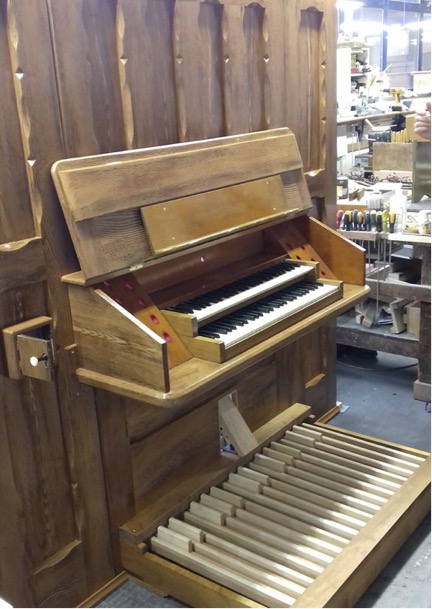
- Image 9: Restored console and new pedalboard in H&H workshop
- Image 10: Restored Pedal pipes reinstalled in organ chamber
- Image 11: Restored Swell box and front casework rebuilt
- Image 12: Restored pipework and mechanisms refitted
- Image 13: Restored Swell pipework
- Image 14: Restored Great pipework
- Image 15: Final stages of the rebuild
- Image 16: Restored console and new pedalboard complete
- Image 17: Restored front casework and pipework complete
- Image 18: Restored console and new pedalboard complete
- Image 19: The fully restored Hill organ at St Bride’s
The organ at St Bride’s is a unique surviving example of Hill’s early work and a wonderful, remarkably versatile instrument. The restoration itself was first mooted in 2009-10, and early groundwork, fundraising and surveys were carried out at that time. A hiatus in 2012-13 for essential repair works to the church put the project on hold, and the fundraising campaign was launched officially in 2014. After another hiatus during the Rector Vacancy in 2015, the project finally entered the home straight in 2016. The contract with Harrison & Harrison Ltd of Durham, leading organ builders specialising in the restoration of historic instruments, was signed in March 2016 and the organ was dismantled in July 2017 for removal to their factory in Durham. In August 2017, a team of specialist stonemasons was brought in to brush down, clean, retool and repair the interior sandstone walls of the organ chamber. This was to minimise future erosion of the walls, and therefore keep the restored organ cleaner for longer.
The organ restoration work took six months, and was unusual in three particular respects. First, St Bride’s commissioned H&H to build a new pedalboard for the organ, to replace the modern, radiating/concave pedalboard that was fitted in 1972. The new pedalboard is straight and flat, and is modelled on a Hill pedalboard of identical vintage to the original. Secondly, the two stops added to the Swell in 1972, Fifteenth and Scharf Mixture, were revoiced, and the Mixture recomposed in a manner befitting the Victorian aesthetic of the instrument. Thirdly, H&H were asked to remove the green paint from the front casework of the organ, as applied in 1972, and to replace it with a wood-coloured finish more in keeping with the architectural surroundings of St Bride’s. All the pipework was cleaned and repaired, the wind reservoir was completely releathered, all soundboards were overhauled, all mechanisms were fully restored and the console was cleaned and stop-knob engravings refilled. The original 1865 bench was restored, and a new, adjustable bench (designed in the Hill style) was commissioned from H&H, to make the instrument accessible and comfortable to play for organists of every shape and size.
The restored Hill organ was inaugurated at a special celebratory recital event in a packed-out St Bride’s on 28 April 2018, given by world-renowned international concert organist, organ pedagogue and organ competition adjudicator, Professor Henry Fairs.
The St Bride’s Hill organ now stands as one of the very finest in the city. It plays a pivotal role in the liturgical life of the church, and is played frequently for concerts, the tuition of organ students and as a tool to engage with the local community.
Max Hepburn
The William Hill & Son organ (1865) of St Bride’s Episcopal Church, Glasgow
| Specification | |
| GREAT ORGAN | |
| Open Diapason | 8 |
| Stopped Diapason | 8 |
| Dulciana | 8 |
| Principal | 4 |
| Wald Flute | 4 |
| Twelfth | 22/3 |
| Fifteenth | 2 |
| Mixture | III |
| Trumpet | 8 |
| SWELL ORGAN | |
| Bourdon | 16 |
| Open Diapason | 8 |
| Stopped Diapason | 8 |
| Principal | 4 |
| Fifteenth | 2 |
| Mixture | III |
| Horn | 8 |
| Oboe | 8 |
| PEDAL ORGAN | |
| Open Diapason | 16 |
| Bourdon | 16 |
| Couplers | |
| Great to Pedals | |
| Swell to Pedals | |
| Accessories | |
| Three composition pedals to Great Organ | |
| Balanced expression pedal to Swell Organ | |
| Tremulant to Swell Organ | |
| Mechanical action | |
| Manual compass 56 notes, pedal compass 30 notes | |
| Watkins & Watson “Discus” blower | |